
The most consequential threats to public health, food security, environmental safety, and national defense operate at the molecular level, and the infrastructure we rely on to detect them does not.
Synthetic opioids killed more than 70,000 Americans in 2023, delivered in compounds weighing micrograms per lethal dose that cross borders in envelopes no imaging system in routine deployment can flag — a pattern, not an anomaly, and the defining one of 21st century risk.
Moreover, molecular threats are asymmetric weapons against social cohesion, not just public health. these threats create uncertainty and blame that foreign adversaries can exploit. Defense infrastructure isn't just a public health investment; it's a national resilience investment, and the absence of it is a standing invitation to asymmetric attack.
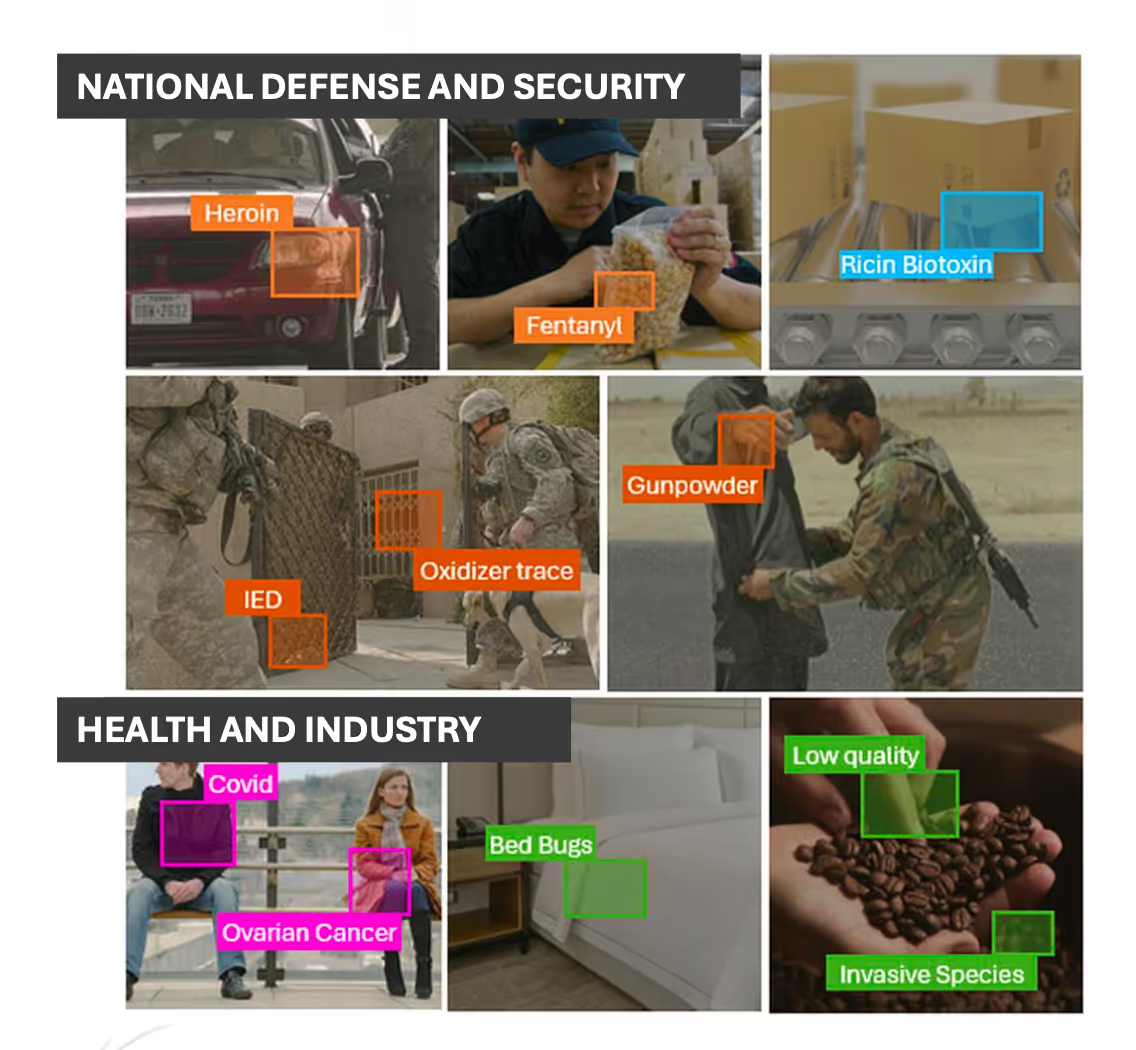
Synthetic drugs and precursors. Fentanyl analogs now appear regularly, each with a slightly modified molecular structure designed to evade scheduled-substance detection, and the finished product is only part of the problem — precursor chemicals move through legitimate industrial supply chains in bulk, indistinguishable from lawful shipments without molecular-level analysis.
Chemical Warfare Agents (CWAs). Novichok-class nerve agents were used in state-sponsored assassination attempts in Salisbury in 2018. VX killed Kim Jong-nam in a Malaysian airport terminal in 2017. These agents are lethal at microgram doses and produce no visible signature. Detection currently requires either a trained dog or a laboratory instrument that arrives after the fact.
Pathogens and pandemic precursors. Infectious agents emit Volatile Organic Compounds (VOCs) — molecular signatures — days before culture-based diagnostics confirm their presence. During the 2022 mpox outbreak, weeks elapsed between initial cases and confirmed cross-border spread. Early-warning molecular surveillance does not exist outside of research settings.
Agricultural disease. Fungal infections in staple crops release VOCs before any visible symptom appears, giving disease time to propagate across thousands of acres before a single intervention is possible. Mycotoxins — particularly aflatoxin — contaminate grain supply chains worldwide, costing billions in rejected exports annually and posing direct health risks in regions without systematic testing. Current practice is spot-check sampling, not continuous monitoring.
Per- and Polyfluoroalkyl Substances (PFAS). These persistent synthetic chemicals contaminate drinking water at parts-per-trillion concentrations in thousands of municipal systems. The United States Environmental Protection Agency (EPA) set the first enforceable limits in 2024. No continuous field-monitoring technology exists to track compliance or detect new contamination events in real time.
Fugitive methane emissions. Oil and gas operators face over $1 billion in cumulative regulatory exposure from undetected methane leaks. Satellites can identify large plumes but cannot pinpoint the specific valve, joint, or wellhead responsible. Ground-level molecular sensing at the source remains a gap.
Antimicrobial Resistance (AMR). Resistant bacterial strains produce distinct VOC signatures detectable in hospital air and wastewater. AMR infections kill over 1.2 million people per year globally. Continuous molecular surveillance of clinical and environmental settings could provide early warning of resistance emergence — but the sensing infrastructure does not exist.
Each of the categories above also functions as an asymmetric pressure point that foreign adversaries can exploit — and in several cases already have.
Fentanyl as geopolitical leverage. Chinese precursor manufacturers supply Mexican cartels with the raw materials for synthetic opioids that kill tens of thousands of Americans per year. Whether or not this constitutes coordinated state policy, the effect is indistinguishable from a low-grade chemical attack on domestic population health, and the political fallout — border policy fights, law enforcement funding battles, harm reduction vs. prohibition debates — consumes legislative bandwidth and erodes institutional trust in ways that serve adversary interests at negligible cost.
Pandemics as trust destroyers. COVID-19 did not just cause mass casualties — it fractured public confidence in the Centers for Disease Control and Prevention (CDC), the World Health Organization (WHO), and the Food and Drug Administration (FDA) along partisan lines that have not recovered. Public trust in scientists has eroded. The inability to detect and contain the pathogen early left an information vacuum that conspiracy filled, and the next pandemic hits a population with even less institutional trust than the last one.
Environmental contamination as a political wedge. PFAS in municipal drinking water, methane leaks near residential communities, industrial chemical spills like East Palestine and Flint — each becomes a symbol of government failure that adversaries amplify through information operations. Localized contamination events that go undetected for months or years generate the kind of justified public anger that is trivially easy to weaponize.
The asymmetry is the point. A foreign adversary does not need to launch a missile when flooding a country with cheap synthetic drugs, or exploiting the absence of molecular surveillance to let a pathogen spread unchecked for weeks, achieves destabilization at a fraction of the cost. The inability to detect molecular threats at the point of entry or emergence is itself the vulnerability — and every month the detection gap remains open, the attack surface for asymmetric exploitation grows.
The gap has two causes — one cultural, one technical.
The cultural cause: detection technology has historically extended human sensory capability — cameras extend vision, microphones extend hearing, radar extends spatial awareness — but the chemical world received no equivalent investment because human cognition is not organized around olfaction. Yes, we have one-offs like smoke detectors, but nothing like a broad-spectrum detector. We have no intuitive frame for what broad, ambient molecular awareness would look like, so we never prioritized building the tools to achieve it.
The technical cause: the engineering problem is genuinely hard. Laboratory instruments — mass spectrometers, gas chromatographs, Ion Mobility Spectrometers (IMS) — can identify trace concentrations with high precision, but they cost hundreds of thousands of dollars per unit, require trained operators, consume prepared samples, and produce results in hours or days. They were designed for confirmation, not continuous surveillance. Attempts to miniaturize them for field deployment sacrifice the sensitivity and selectivity that make them useful in the first place.
Electronic noses — sensor arrays using metal oxides or conducting polymers — have been in development for decades, but they struggle with three problems that biological olfaction solves effortlessly: selectivity in complex backgrounds (real-world air contains thousands of compounds simultaneously), sensor drift over time from humidity, temperature, and chemical poisoning, and a sensitivity floor that typically bottoms out at parts-per-million, orders of magnitude above the parts-per-trillion concentrations where threats like fentanyl and nerve agents operate. Electronic noses will also never reach the temporal resolution that we need: Recovery rates for those sensors to "clear residuals" is on the order of 3-10 minutes, but for real-world deployment of detection, we need sensors that clear in seconds. This rate-limiter is a ceiling imposed by the laws of physics.
Detection dogs already solve this problem in narrow operational contexts, identifying fentanyl, explosives, pathogens, and cancer-associated VOCs at parts-per-trillion concentrations, in milliseconds, in uncontrolled field environments — across roughly 60,000 working dogs in the United States alone. The biological capability is proven, and what is missing is instrumentation that can capture, digitize, and transmit that capability as structured data across a network, continuously, at scale, without the logistical constraints of a living animal.
Sensitivity alone is not sufficient — the sensor network must also be updatable. New fentanyl analogs, novel pathogens, and emerging industrial contaminants appear on timescales of weeks to months. A fixed-function detector deployed at a port today is blind to the compound that appears next quarter. The required infrastructure is a networked sensor that can be retrained over the air — the same way antivirus signature databases push to every endpoint on a network overnight. A sensor that cannot receive remote updates is obsolete the moment the threat landscape shifts.
When the next novel pathogen is identified in one city, a networked and updatable molecular sensing system could begin screening for it in every connected facility worldwide within hours. That capability — global molecular surveillance with same-day update cycles — is the foundational requirement for credible biosurveillance, and it does not exist today.
The threat categories listed above are not static. Synthetic biology is lowering the cost of engineering novel compounds. AI-assisted chemistry is accelerating drug and materials discovery, with dual-use implications that both Anthropic and OpenAI have documented in their biological threat evaluations. The molecular threat surface is expanding faster than the detection infrastructure that is supposed to contain it.
Every month that gap remains open is measured in lives lost, crops destroyed, water contaminated, and the institutional trust that erodes when threats go undetected long enough to become political. The sensing technology to close it is no longer theoretical — the question is whether we deploy it before the next crisis, or after.
---
General Sense is building the sensing infrastructure for the molecular layer of the physical world.