Americans visit a physician roughly four times per year — fewer than citizens of most other developed nations. Even less frequent are routine check ups and screening for diseases. Between those visits, the body's biochemistry goes entirely unmonitored and costs the American healthcare system in treating diseases that could have been thwarted if they had been caught earlier.
This gap matters because disease does not wait for scheduled appointments. Every major disease process — cancer, infection, metabolic dysfunction, neurodegeneration — alters the body's volatile chemistry from its earliest stages, often weeks, months, or years before symptoms prompt a clinical visit. Tumors produce aldehydes and alkanes through lipid peroxidation as reactive oxygen species degrade cell membranes. Bacterial infections generate species-specific metabolites. Diabetic ketosis elevates breath acetone to six times the healthy baseline. Parkinson's disease changes the volatile composition of sebum years before motor symptoms appear.
These are not theoretical signals. They have been measured, published, and replicated. Over 1,000 Volatile Organic Compounds (VOCs) have been identified in human breath alone — a chemical landscape first mapped by Linus Pauling in 1971 and expanding with every new study. More than 265 putative VOC biomarkers have been linked to specific cancer types. Disease-associated volatile signatures have been documented in breath, urine, sweat, saliva, and sebum.
Detection dogs have already proven these volatile signatures can be read with high accuracy, as the next section details. The limitation is not whether the chemistry can be sensed, but rather that canine detection doesn't scale. A technology that captures that same capability continuously and broadly would mean detecting disease when it begins, not when symptoms finally drive a patient to schedule a visit.
The canine olfactory system detects compounds at 1–1.5 parts per trillion — roughly 100,000 times more sensitive than human smell and several orders of magnitude beyond any portable electronic sensor. And for two decades, researchers have been testing whether that sensitivity can detect disease.
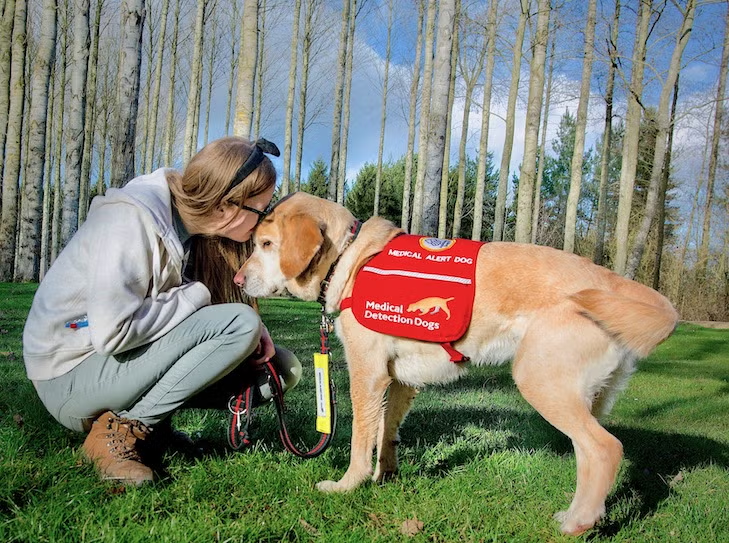
In cancer detection, trained dogs have identified at least ten tumor types from biological samples. McCulloch et al. (2006) reported 99% sensitivity and 99% specificity for lung cancer from breath — numbers that exceed low-dose CT screening. Taverna et al. (2015) achieved 98.6–100% sensitivity for prostate cancer from urine across 902 subjects, dramatically outperforming the Prostate-Specific Antigen (PSA) test, which has a sensitivity of roughly 21% at the standard cutoff. Sonoda et al. (2011) demonstrated 91% sensitivity and 99% specificity for colorectal cancer from breath — comparable to colonoscopy without the invasiveness. The most recent large-scale study, Half et al. (2024), screened for breast, lung, prostate, and colorectal cancers simultaneously from breath samples across 1,386 subjects: 93.9% sensitivity, 94.3% specificity, 1.5% false positive rate.
In infectious disease, the evidence moved from laboratory to operational deployment during the COVID-19 pandemic. At Helsinki-Vantaa International Airport, a triple-blinded randomized trial found trained dogs agreed with RT-PCR results 98% of the time while screening approximately 300 passengers per hour. A beagle named Cliff detected Clostridioides difficile (C. diff) on hospital ward rounds at 83% sensitivity and 98% specificity — and two of his apparent false positives were patients who developed C. diff within three months, suggesting he was detecting the infection before it was clinically diagnosable. Dogs identified asymptomatic malaria from the scent of worn socks at 70–73% sensitivity and 90–91% specificity, with the samples tested nearly two years after collection.
In neurology, a 2019 study proved that a seizure-specific odor exists — dogs detected it across patients and seizure types at 86.8% sensitivity and 98% specificity. A follow-up study found dogs identified seizure scent an average of 68 minutes BEFORE onset, with specific VOCs — menthone, camphor, pentadecanal — characterizing the pre-ictal period. For Parkinson's disease, canine detection from sebum swabs achieves 89% sensitivity and 87% specificity, detecting a disease that is currently diagnosed only after 60–80% of dopaminergic neurons have already been lost.
The pattern across all of these studies is the same: the chemical signal appears before the clinical diagnosis, often by weeks, months, or years.
The question is not whether early detection matters. The question is whether current screening infrastructure actually delivers it.
The answer, for most cancers, is no.
According to Surveillance, Epidemiology, and End Results (SEER) Program data, 52% of lung cancers are diagnosed at the distant stage, where the five-year survival rate is 9.7% — compared to 64.7% for localized disease. Roughly 80% of ovarian and pancreatic cancers are caught after metastasis. Ovarian cancer has no approved population screening test. Pancreatic cancer has no early detection method of any kind.
Even where screening exists, it underperforms. Mammography misses approximately one in eight breast cancers, with higher miss rates in dense tissue. PSA testing for prostate cancer has a Positive Predictive Value of roughly 30% — meaning 70% of men who test positive do not have cancer! Colonoscopy misses approximately one in five adenomas, and a 2025 systematic review suggests the true miss rate for white-light colonoscopy may be closer to one in three.
The economic consequences scale accordingly. Stage IV lung cancer costs Medicare $148,426 in the first year — 2.7 times the $54,606 for Stage I. Stage IV breast cancer costs $182,655 over 24 months versus $71,909 for Stage 0. Across all cancer types, later-stage diagnosis drives costs up to seven times higher.
Hospital-acquired infections compound the burden. C. diff alone costs the US healthcare system over $3 billion annually with approximately 14,000 deaths per year. One in 31 hospitalized patients has at least one Hospital-Acquired Infection (HAI) at any given time. Sepsis, often triggered by undetected infection, kills at a 34.2% rate in its most severe form and costs over $32,000 per case.
The tools doctors are given operate in the wrong modality to catch these diseases early — measuring proteins, cells, and images when the earliest signals are molecular, and most importantly, volatile.
If volatile biomarkers are real and measurable, why hasn't someone built an electronic sensor to detect them?
Many have tried, and in fact, the industry is graveyard of failed attempts.
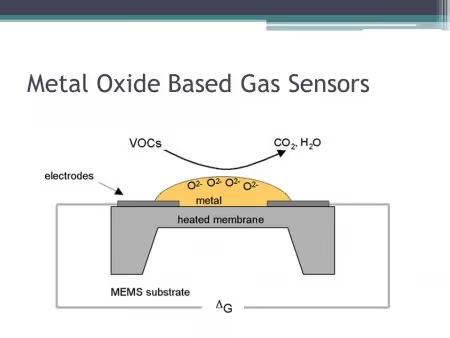
Metal oxide semiconductor (MOS) sensors — the basis of most electronic noses — detect at 100–400 parts per billion. Canine olfaction detects at 1–1.5 parts per trillion. That is a five-to-six order of magnitude gap. Even beyond raw sensitivity, e-noses suffer from sensor drift — unpredictable degradation of response over time — humidity interference from human breath, cross-reactivity between compounds, and a fundamental receptor diversity mismatch: dogs have approximately 1,000 olfactory receptor types generating billions of combinatorial neural patterns; a typical e-nose array uses 8 to 32 sensors. This is a huge edge for dogs being able to discriminate odors: Imagine how much more you can communicate with a 1000-word vocabulary as opposed to knowing only 32 words.
Companies including Owlstone Medical, The eNose Company, Breathomix, and Sensigent have spent years bringing breath-analysis devices to clinical trials. Owlstone's LuCID trial has enrolled up to 4,000 patients across 26 European hospitals for lung cancer breath detection. The eNose Company completed multi-center validation for lung cancer in 2022. None has achieved commercial-scale clinical deployment. The pattern across the field is consistent: promising laboratory results, extended clinical validation timelines, and a sensor technology that has not yet closed the gap to biological olfaction.
The MIT team that built a system incorporating stabilized mammalian olfactory receptors described their device as "200 times more sensitive than a dog's nose" at detecting individual molecules but "100% dumber" at interpreting complex mixtures. The bottleneck is not detecting one compound. It is reading the pattern across hundreds of compounds simultaneously — the exact computation that biological olfaction performs in real time.

Continuous Glucose Monitors (CGMs) offer the clearest precedent for what happens when a molecular signal moves from episodic testing to continuous monitoring. Time in Range — the key diabetes management metric — improved from 18% with finger-stick self-monitoring to 74% with CGMs. Severe hypoglycemia episodes dropped from 3.01% to 0.2%. The clinical paradigm shifted from "manage by periodic lab draws" to "manage by continuous signal."
General Sense is building the equivalent for the broader volatile chemical landscape. The company's neural interface reads directly from the canine olfactory bulb — the neurological structure where raw chemical information converges — and decodes what the dog smells in real time. The system captures the full discriminative power of biological olfaction at parts-per-trillion sensitivity and sub-second speed, outputting continuous molecular telemetry: chemical identity, estimated concentration, location, timestamp. New detection targets are programmed in software, not trained behavior over months. A single dog becomes a multi-target chemical sensor covering any compound the olfactory system can resolve.
In healthcare, this translates to continuous health monitoring at home, the clinic, or at work. Facility entry screening for respiratory pathogens without swabs or wait times. Hospital ward monitoring for HAI markers before clinical presentation. Non-invasive multi-cancer VOC screening at primary care visits in seconds, not weeks. Pre-symptomatic detection of neurological conditions through volatile biomarkers present years before motor or cognitive symptoms.
To be clear, this is NOT a replacement for clinical diagnostics — it is rather a first-pass molecular screen that determines who needs further workup, deployed at the speed of breathing rather than the speed of lab processing.
The VOC biomarker literature identifies hundreds of candidate compounds across dozens of diseases, but no single VOC or VOC panel has completed the full clinical trial pipeline for regulatory approval. The Bauër et al. 2022 systematic review of canine cancer detection found that only 6 of 62 published studies used rigorous double-blind, screening-like conditions. Multi-cancer screening from a single breath sample has been demonstrated in one large study. The extension from trained behavioral detection to neural-decoded olfaction is biologically plausible but has not yet been tested in clinical disease detection settings.
The field is pre-regulatory, but the biology is established. The clinical validation infrastructure is being built. And the core question — whether continuous molecular monitoring changes outcomes the way continuous glucose monitoring changed diabetes — cannot be answered until the sensing technology exists to run the trials.
---
General Sense is a sensory reasoning company building neural interfaces for the canine olfactory system. For more information: [email protected]