👉 Read the article here (paywall)
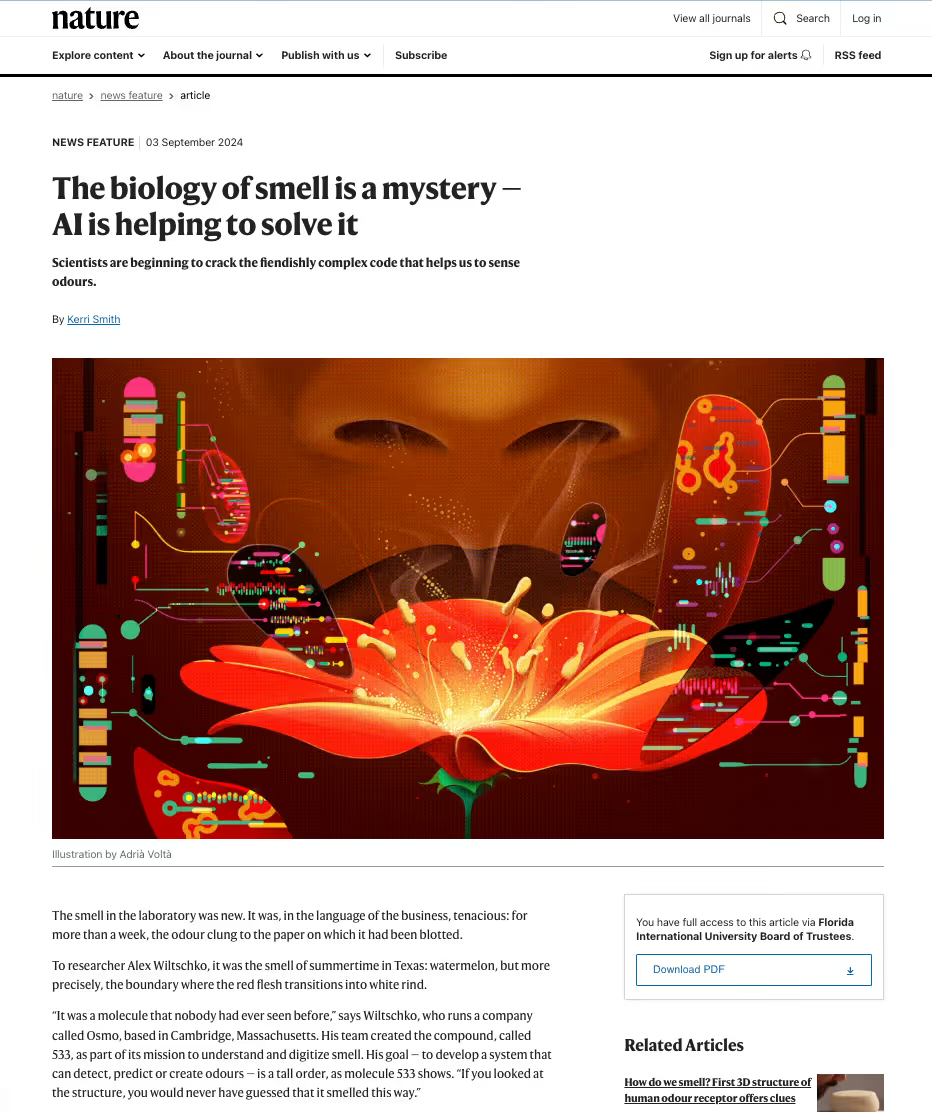
When Nature — arguably the most prestigious scientific journal in the world — publishes a feature on the future of olfaction, and your technology is cited as a leading example of what comes next, it marks a turning point.
In her September 2024 feature "The Most Mysterious Sense: Cracking the Odour Code," science journalist Kerri Smith surveys the entire frontier of smell research: from Artificial Intelligence (AI) models that predict how molecules smell, to cryo-electron microscopy revealing the first atomic-resolution structures of human olfactory receptors, to neuroscientists working to decode how the brain converts chemical signals into conscious perception.
General Sense — then operating as Canaery — appears at the culmination of the piece, where Smith turns from basic science to applied technology. She describes our Nose-Computer Interface (NCI): an electrode array placed on the olfactory bulb that records neural firing patterns as an animal processes scent, decoding odor identities from neural activity in real time. Dima Rinberg, co-founder and neuroscientist at New York University (NYU) School of Medicine, is quoted directly: "The biological nose is the best chemical detector. The whole machinery is hard to beat."
The Nature feature correctly situates our work within the broader olfaction research landscape, but the story it tells is primarily scientific. What it doesn't cover is the engineering leap required to move from a laboratory demonstration to a field-deployable system.
At the time of publication, our team had already demonstrated real-time chemical identification in rat models — detecting arson accelerants, smokeless powder, methamphetamine, cocaine, and fentanyl — using a 128-electrode array developed in partnership with Lawrence Livermore National Laboratory (LLNL). This is all also in a format in which we can deploy our rats in the real world. The next-generation 767-electrode array was already in development, designed to dramatically improve performance against complex background odors and confounding vapors encountered in real-world field conditions.
The article also frames the broader competitive landscape accurately: electronic noses have been in development for 40 years, yet biological olfaction still outperforms every synthetic sensor by orders of magnitude.
That gap is the core thesis behind General Sense. Rather than trying to replicate biology with inferior hardware, we work with biology — pairing the unmatched sensitivity of mammalian olfactory systems with AI-powered neural decoding to create something neither can achieve alone.
Being featured in Nature alongside researchers from Harvard Medical School, the Monell Chemical Senses Center, the Rockefeller University, and the University of California San Francisco (UCSF) is a signal that our approach has earned scientific credibility at the highest level.