
Over the past fifty years, satellite-based Earth observation has transformed how we monitor the planet. Landsat, Sentinel, Planet Labs, and a growing constellation of hyperspectral instruments give us unprecedented views of land use, vegetation health, ocean color, and atmospheric composition. This is extraordinary technology. It is also, by the laws of physics, blind to chemistry at the concentrations that matter on the ground.
Satellites measure reflected and emitted electromagnetic radiation — photons bouncing off surfaces. Volatile Organic Compounds (VOCs) — the gas-phase molecules emitted by diseased plants, stressed animals, contaminated soil, and invasive organisms — do not reflect light in spectrally distinguishable ways at field-relevant concentrations. A citrus tree colonized by a lethal bacterium, a steer incubating respiratory disease, a patch of soil harboring an invasive root pathogen: all of these emit molecular signatures at parts-per-trillion that are detectable at ground level but physically invisible from orbit.
Satellites observe the electromagnetic spectrum, but the chemical world operates in a different domain entirely. And that domain — the molecular layer of the physical world — has no sensor network.
The economic case for early chemical detection in agriculture is not hypothetical. It has already played out, catastrophically, in the collapse of Florida's citrus industry.
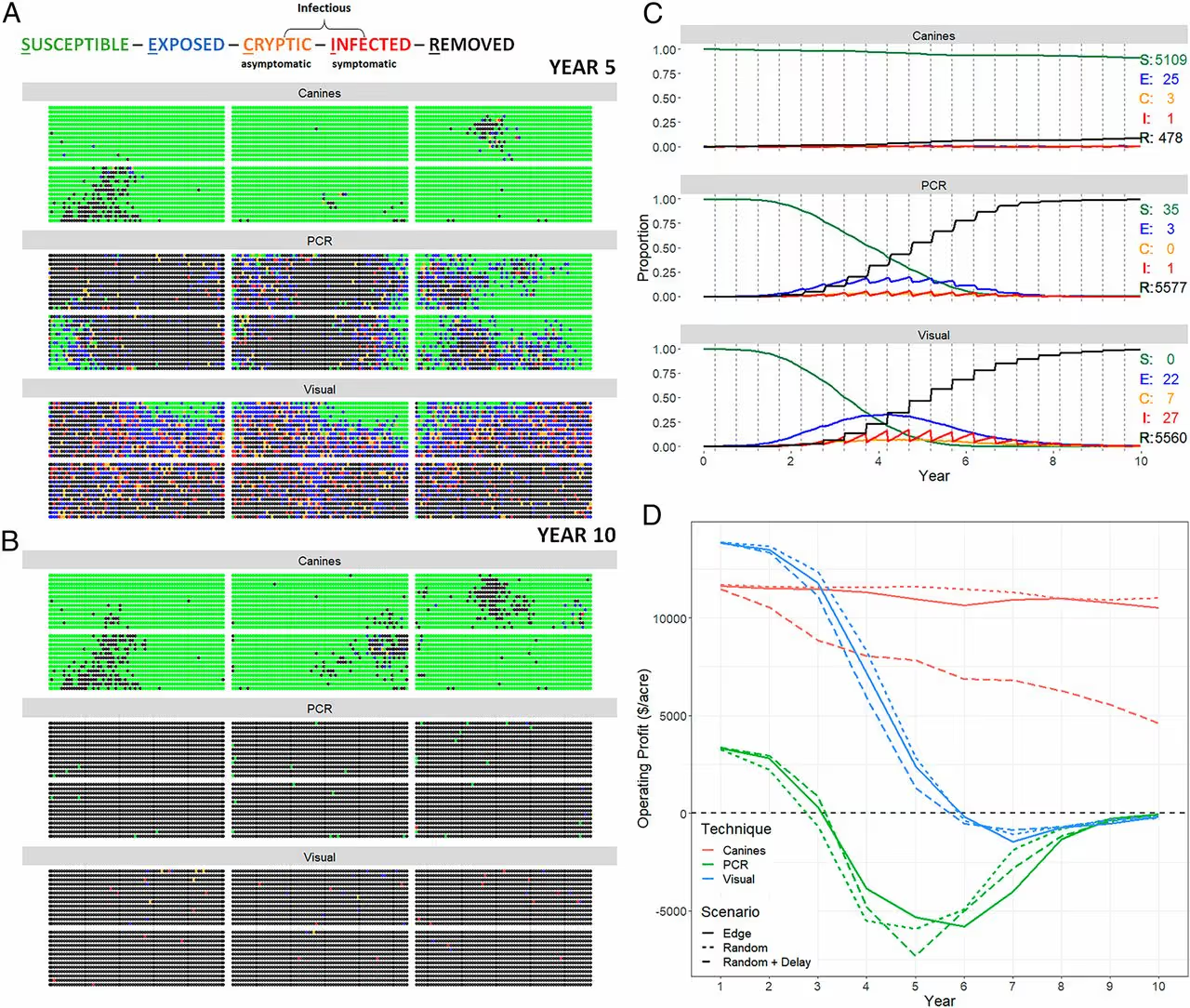
Huanglongbing (HLB), caused by the bacterium Candidatus Liberibacter asiaticus (CLas), entered Florida around 2005. By the time the disease was detectable through conventional means — visual inspection and Polymerase Chain Reaction (PCR) testing — the pathogen had already established across the state. Production fell from approximately 300 million boxes in 2003-04 to fewer than 12 million boxes projected for 2024-25, a decline exceeding 90%, with total economic losses surpassing $4.51 billion from 2006 to 2011 alone.
trained detection dogs identified infected trees at 99% accuracy in approximately two seconds per tree.
The relevant fact: CLas-infected trees emit altered volatile signatures detectable by scent within two weeks of infection. In a 10,000-tree trial, trained detection dogs identified infected trees at 99% accuracy in approximately two seconds per tree. PCR — the only USDA-approved confirmatory test — detected fewer than 3% of infections at two months post-inoculation. The pathogen was chemically detectable long before it was spectrally visible or genetically confirmable. The intervention window existed. There was no technology deployed to use it.
This pattern repeats across plant pathology. Dogs have demonstrated ~95% accuracy detecting laurel wilt in avocado trees before external symptoms appear — a disease that has killed over 300 million laurel trees in the United States. Phytophthora root rot, which destroys plants from the root zone upward and is entirely invisible from above, has been detected in soil at 100% accuracy in laboratory settings and 89% in the field. Citrus canker detection exceeds 98% accuracy at one to two seconds per tree.
The structural problem is consistent: satellites see the canopy. Disease begins in roots, vascular tissue, and lower plant structures. By the time spectral changes reach the upper canopy — the only part visible from orbit — the infection is typically advanced. Published research is direct: "Reliable remote sensing monitoring of plant diseases and pests is usually achieved when symptoms are fully exhibited." For many diseases, full exhibition means the plant is already unrecoverable.
The same gap extends to post-harvest losses. Mycotoxin contamination of grain — aflatoxin, deoxynivalenol (DON), fumonisin — costs U.S. agriculture up to $1.68 billion annually. No field-deployable rapid test exists. The fungi emit characteristic VOC profiles during colonization, well before toxin levels reach regulatory thresholds. The chemical signal is there. The sensor infrastructure is not.

Individual animal health is a proximity problem. Wearable sensors track motion and temperature but not metabolic chemistry. The result is that the most economically significant livestock diseases are diagnosed late — after clinical signs appear, after organ damage has progressed, and after the window for low-cost intervention has narrowed.
Bovine Respiratory Disease (BRD) is the leading cause of morbidity and mortality in feedlot cattle, costing the U.S. beef industry an estimated $1 billion to $4 billion annually. BRD is a syndrome caused by multiple pathogens — Mannheimia haemolytica, Pasteurella multocida, Mycoplasma bovis, and several viral agents — often triggered by transport stress. Clinical signs appear late. By the time a steer is visibly sick, lung consolidation is often irreversible.
The chemical signal precedes the clinical sign. Breath VOC profiles of BRD-infected cattle show altered concentrations of acetaldehyde, decanal, phenol, and other markers. Canine detection studies have shown mixed results — one dog achieved 73% accuracy while others performed near chance levels — but the challenge is instructive. BRD's multi-pathogen etiology means there is no single VOC signature; conventional scent training, which targets one odor pattern, may be structurally insufficient for a syndrome with variable chemical presentations.
Other livestock targets reinforce the pattern. Dogs have detected mastitis through Staphylococcus aureus-specific VOCs (Texas A&M AgriLife, 2022). Estrus detection has been validated by canine olfaction, though the 15-month training requirement per dog makes it economically prohibitive at scale. The frontier targets — African Swine Fever (ASF), Highly Pathogenic Avian Influenza (HPAI) — have not been studied in canine detection contexts, but both diseases produce systemic metabolic changes that would logically alter VOC profiles. ASF alone has caused the culling of over 300 million pigs globally since 2018.
Invasive species cost the United States $21.08 billion per year, with agriculture as the most impacted sector.
The dominant management framework is Early Detection and Rapid Response (EDRR): find invasive organisms early, eradicate them before they establish. The framework is sound. It fails in practice because the detection phase — its most critical link — depends on visual surveys, periodic sampling, and citizen reports. By the time an infestation is visually apparent, the population has typically exceeded the threshold for cost-effective eradication.
Across 34 comparative studies, conservation detection dogs outperformed humans and other survey tools in 91% of cases.
Chemical detection compresses this window. In forests, dogs found 3.4 times more spotted lanternfly egg masses than human surveyors — a pest that causes 80-100% vine mortality in a single growing season. Dogs detected Asian longhorned beetle at 92-93% field accuracy in double-blind trials, discriminating target species from native wood borers. Emerald ash borer — whose internal larval feeding is invisible to external inspection — was detected at 73-100% sensitivity across seven experimental settings. In Guam, dogs find brown tree snakes five times faster than other search methods.
Across 34 comparative studies, conservation detection dogs outperformed humans and other survey tools in 91% of cases. The limiting factors are not biological sensitivity — dogs detect at parts-per-trillion — but operational scalability: months to years of training per odor target, one to two reliable targets per dog, handler dependency, 30-minute work cycles, and binary alerts with no quantitative data stream.
The detection capability is proven. The delivery mechanism does not yet scale to the size of the problem.
With General Sense, dogs can "work" while just having fun. Running around in a forest is more sustainable for hours when it is not tied to intense attention and motivation demands. As long as the dogs can smell, our neural interfaces does all of the thinking while their brains can take a rest.

Three environmental challenges illustrate the same structural gap.
Satellite instruments can identify large point sources emitting more than 100 kilograms per hour, but these super-emitters account for only about 25% of total emissions. The remaining 75% — from small wellheads, aging infrastructure, and distributed agricultural sources — falls below satellite detection thresholds. Low-producing oil and gas wells, which generate only 6-7% of U.S. fuel output, account for roughly 50% of the sector's methane emissions. Ground-level sensing is the only viable path to the majority of the emissions inventory.
Per- and Polyfluoroalkyl Substances (PFAS) — "forever chemicals" — are regulated at concentrations so low that the EPA's interim health advisory levels fall below the minimum detection limits of approved analytical methods. Current detection requires laboratory-based High-Performance Liquid Chromatography coupled with Mass Spectrometry (HPLC-MS) at $300-500 per sample with multi-day turnaround. Field-portable detection at regulatory-relevant concentrations is an unsolved problem. Emerging technologies are in development, but none are commercially deployed at scale.
Seattle Public Utilities deploys a PCB-detection dog on the Lower Duwamish Waterway Superfund site that has identified previously unknown contamination sources invisible to human inspection
Evidence gathering for environmental crime is overwhelmingly reactive: inspectors respond to complaints, collect point-in-time samples, and send them to laboratories. Intermittent discharges — nighttime dumping, episodic overflow events — are routinely missed. The precedent for something better exists in narrow form: Seattle Public Utilities deploys a PCB-detection dog on the Lower Duwamish Waterway Superfund site that has identified previously unknown contamination sources invisible to human inspection. Environmental Canine Services has operated for over twelve years detecting illicit sewage discharges for municipalities, leading directly to beach reopenings. Continuous chemical monitoring that produces timestamped, geolocated molecular records would represent a fundamentally new class of environmental evidence — but it requires a sensor that can operate continuously, at the relevant sensitivity, at ground level.
The evidence surveyed above points to a consistent conclusion: chemical detection at ground level works, is often the only method that catches problems early enough to act, and does not scale under current delivery mechanisms.
A single dog covers approximately 130 acres per day.
General Sense is building the infrastructure to change that. The company deploys neural interfaces on the canine olfactory bulb — the neurological structure where raw scent information converges — and decodes what the dog smells in real time. The system reads the olfactory neural signal directly, bypassing behavioral training entirely. Any adequately socialized dog becomes a chemical detection platform. Sensitivity at parts-per-trillion. Detection speed under 0.4 seconds. Accuracy exceeding 96%. Target compounds programmed in software, not trained over months — the same dog scans for plant pathogens, soil contamination, invasive species markers, and livestock disease indicators in a single pass. A single dog covers approximately 130 acres per day.
The output is a continuous stream of molecular telemetry — chemical identity, concentration estimate, GPS coordinates, timestamp — generated passively as the dog moves through the environment. Across a fleet, this becomes a spatiotemporal chemical dataset: a record of what molecules are present, where, and when, at a resolution and sensitivity that no other technology produces.
The analogy is Planet Labs. Before Planet, satellite imagery was sparse, expensive, and infrequent. Planet's insight was that continuous daily coverage at moderate resolution was more valuable than occasional high-resolution snapshots, because temporal density reveals change. General Sense applies the same logic to chemistry. Continuous molecular telemetry at ground level reveals chemical change — disease onset, contamination events, species arrival, ecosystem stress — that accumulates into a baseline against which anomalies become detectable with increasing confidence over time.
This data layer is uncorrelated with every existing Earth observation modality. It captures a dimension of the physical world that has never been measured at scale.
---
General Sense is a sensory reasoning company building neural interfaces for the canine olfactory system. For more information: [email protected]