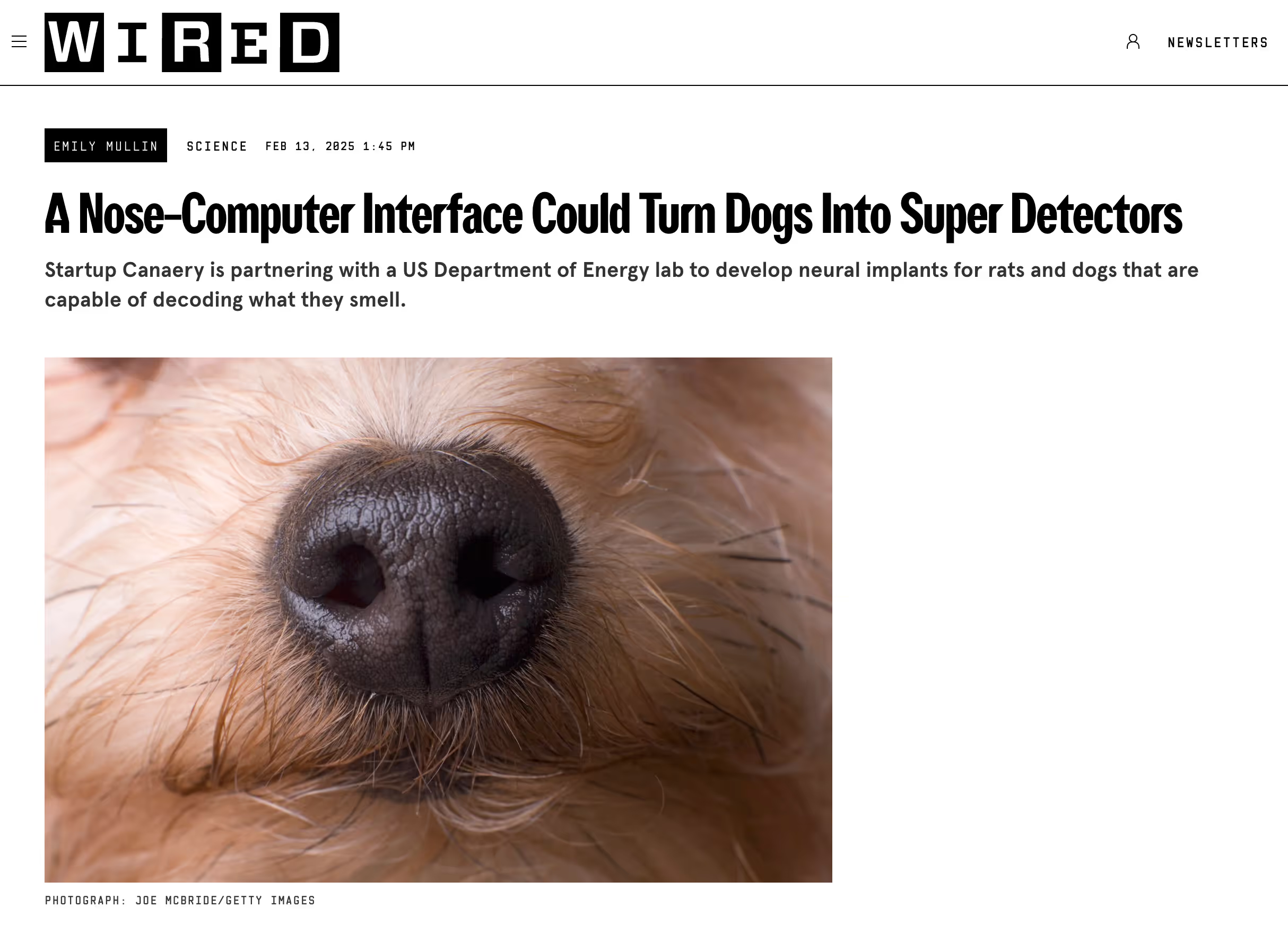
In February 2025, WIRED published the first in-depth look at our technology in operation — including an exclusive demo video showing the Nose-Computer Interface (NCI) identifying chemical compounds in real time.
Emily Mullin's reporting walks through the full system architecture: an air sample captured by a wand, delivered to a pod housing an animal equipped with the NCI, neural signals decoded by AI, and the compound identity displayed on a mobile app within seconds — complete with a quality score reflecting accuracy and molecular concentration. WIRED also confirmed our partnership with Lawrence Livermore National Laboratory (LLNL), a Division of the United States (U.S.) Department of Energy (DOE), to develop the electrode array at the heart of the system.
The article frames General Sense within the Brain-Computer Interface (BCI) movement, drawing a direct comparison to Elon Musk's Neuralink. Where Neuralink builds BCIs for the human brain, we build NCIs for the biological nose. Matt Angle, Chief Executive Officer (CEO) of Paradromics — another leading BCI company — called our approach "a pragmatic way to digitize smell" that "leverages the very hard-to-engineer physiology of olfaction while still getting the benefit of digitization and rapid analysis."
Joel Mainland, an olfaction researcher at the Monell Chemical Senses Center, added independent validation: "Animals can do things that we can't get current sensors to do, so that's a smart way to get around that problem."
WIRED's reporting focused — understandably — on the demo and the hardware. What the piece doesn't explore is the AI layer that makes the system transformative rather than merely novel.
Traditional sniffer dogs require months of behavioral conditioning to alert on a single class of compounds. Our NCI trains the software, not the animal. A new odor signature can be added to the system's library in approximately three sessions — exposing the animal to two dozen samples of a target compound, then validating the model. This means the same animal can cover an arbitrarily large and expanding catalog of target chemicals without retraining.
The article also touches on concentration measurement but doesn't explain its strategic importance. In border security scenarios, sophisticated smuggling operations deliberately contaminate entire shipping containers with trace amounts of target substances, causing trained dogs to alert indiscriminately. Because the NCI reads the actual neural magnitude of the response, our system can map concentration gradients — telling an operator not just what is present, but where the highest concentrations are, enabling precise localization of concealed contraband.
Finally, the WIRED piece raises the question of animal welfare — an important topic we take seriously. The electrode array is thinner than tissue paper, implanted via minimally invasive procedure, and our data in rat models shows no tissue damage and no significant immune response. The technology does not alter animal behavior or quality of life. We are committed to the highest standards of ethical animal partnership as we scale.
WIRED reaching out for an exclusive demo — and comparing us to Neuralink — reflects a broader recognition that the NCI is not an incremental improvement to existing detection technology. It is a new category. Where electronic noses have spent 40 years trying to match biology and failing, we made the paradigm shift: work with biology, decode it digitally.